
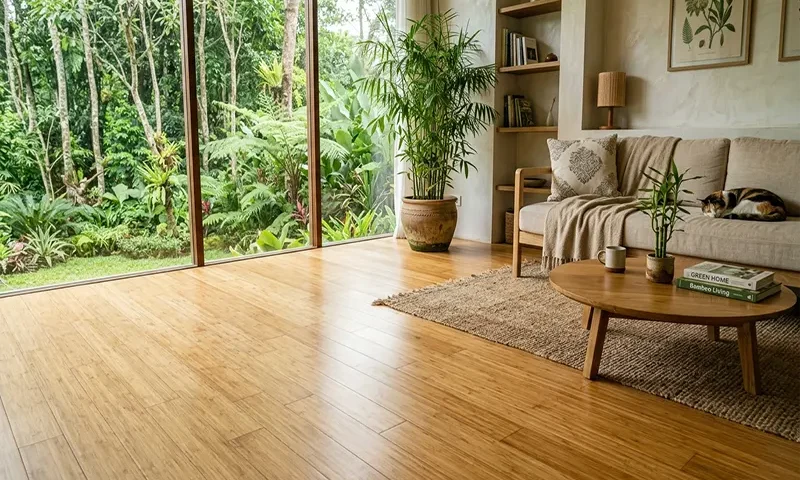
As the construction industry pivots toward regenerative practices in 2026, one material stands out for its ability to harmonize industrial performance with ecological integrity: Moso Bamboo. Known scientifically as Phyllostachys edulis, Moso is not merely a “green” alternative to hardwood; it is a specialized, high-performance grass that is revolutionizing how we think about sustainable flooring.
For the eco-conscious homeowner, choosing Moso bamboo is a statement of intent—a commitment to a material that heals the planet as quickly as it is harvested.
The Biological Advantage: Why Moso Matters
While there are over 1,500 species of bamboo, Moso is the “giant” of the family and the only species with the fiber density required for premium flooring. Its sustainability is rooted in its extraordinary biology:
- Rapid Maturity: Unlike an Oak or Walnut tree, which requires 50 to 100 years to reach harvestable age, Moso bamboo matures in just 4 to 5 years.
- Self-Regenerating: Bamboo is a grass with an extensive underground rhizome system. When a stalk is harvested, the “mother plant” does not die. Instead, it continues to send up new shoots, making it a naturally self-renewing crop.
- Carbon Sequestration: Moso plantations can sequester up to 35% more carbon dioxide than an equivalent stand of trees, releasing massive amounts of oxygen back into the atmosphere during its growth cycle.
Life Cycle Assessment: Carbon Neutrality in Your Living Room
A true eco-friendly home requires materials with a low or negative carbon footprint. A comprehensive Life Cycle Assessment (LCA) of Moso bamboo reveals that it can be CO2 neutral—or even carbon negative—over its full lifespan.
This is achieved because the carbon absorbed during the plant’s rapid growth is “locked” into the flooring planks for decades. When sourced from responsibly managed forests and processed with renewable energy, the sequestration often outweighs the emissions produced during shipping and manufacturing.
Moso Flooring Styles & Technical Applications
Moso bamboo is versatile, offering different aesthetics and density levels depending on how the raw stalks are processed.
1. Side Pressed (Vertical Grain)
The bamboo strips are turned on their side and glued together. This creates a narrow, linear grain that is perfect for minimalist and modern interiors. It highlights the clean, uniform look of the fibers.
2. Plain Pressed (Horizontal Grain)
The strips are glued together horizontally, showcasing the characteristic “knuckles” or nodes of the bamboo stalk. This is the most traditional look and clearly identifies the material as a natural grass.
3. Strand Woven (The Performance Leader)
Strand woven Moso is the pinnacle of bamboo technology. The fibers are shredded, coated in resin, and compressed under extreme pressure. This results in a plank that is incredibly dense and stable, making it ideal for high-traffic commercial spaces or busy homes with large pets.
Comparison: Moso Bamboo vs. Traditional Hardwoods
| Feature | Moso Bamboo (Strand) | White Oak | Black Walnut |
| Janka Hardness | 3,000 – 4,000+ lbf | 1,360 lbf | 1,010 lbf |
| Maturity Cycle | 4 – 5 Years | 60 – 80 Years | 50 – 70 Years |
| CO2 Footprint | Potentially Negative | Neutral/Positive | Positive |
| Stability | Very High | Moderate | Moderate |
The “Healthy Home” Factor: Indoor Air Quality
Sustainability isn’t just about the planet; it’s about the health of the people living inside the home. Poorly manufactured bamboo can contain high levels of formaldehyde in the adhesives. To ensure your home remains a sanctuary, look for the following standards:
- E0 and E1 Standards: These are European benchmarks for formaldehyde emissions. E0 represents the lowest possible detectable level.
- VOC Ratings: Look for products with an A or A+ rating for volatile organic compound (VOC) emissions to ensure no harmful off-gassing occurs after installation.
- LEED & BREEAM Credits: Architects often specify Moso bamboo because it contributes to LEED v4.1 credits in categories like “Low-Emitting Materials” and “Sourcing of Raw Materials.”
Longevity and Circularity
A floor that needs to be replaced every decade is not truly sustainable, regardless of its origin. Moso bamboo is prized for its dimensional stability. Unlike solid wood, it is less prone to “cupping” or “gapping” when exposed to humidity changes. This makes it one of the few natural materials suitable for installation over underfloor heating systems.
End-of-Life: Closing the Loop
At the end of its 30-to-50-year lifespan, Moso bamboo flooring follows the principles of the circular economy:
- Upcycling: Old planks can be ground down to create chipboard or MDF.
- Biomass: It can be used as a clean-burning biomass energy source, returning its stored energy to the grid.
The Green Buyer’s Checklist
When shopping for Moso bamboo, use this checklist to verify the supplier’s eco-claims:
- [ ] FSC Certification: Does the bamboo come from a Forest Stewardship Council-certified plantation?
- [ ] Formaldehyde-Free: Is the product certified as “NAUF” (No Added Urea-Formaldehyde)?
- [ ] Finish Type: Are the top coats water-based or UV-cured to prevent chemical odors?
- [ ] Warranty: Does the manufacturer offer at least a 25-year structural warranty?
Sustainable Moso bamboo flooring is more than just a trend; it is a vital component of the 2026 green building movement. By selecting Moso, you are choosing a material that offers the hardness of exotic hardwoods, the elegance of premium design, and the environmental conscience of a rapidly renewable resource. It is a flooring choice that allows your home to grow in beauty while allowing the planet to breathe a little easier.

