
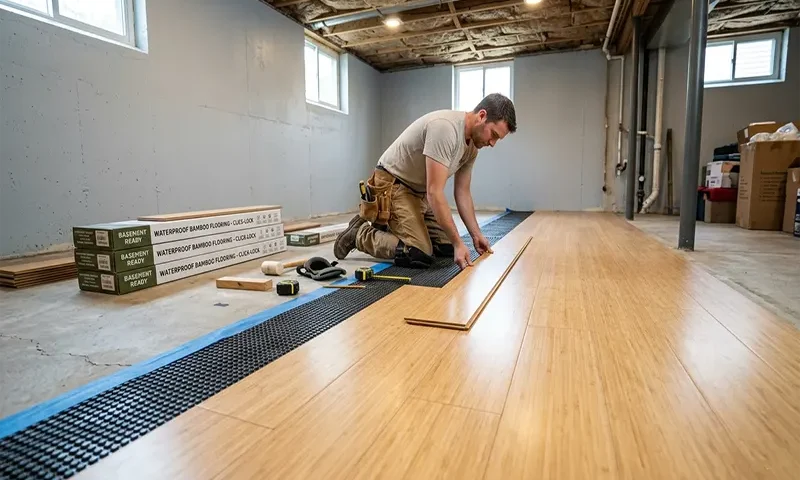
Basements have long been a challenge for homeowners seeking the warmth of natural wood finishes. Traditionally, the threat of hydrostatic pressure, high humidity, and potential flooding made organic materials like solid bamboo a risky investment. However, the introduction of waterproof click lock bamboo has fundamentally shifted this paradigm.
Modern waterproof bamboo is not a solid grass plank; rather, it is a high-tech composite typically featuring a Stone Plastic Composite (SPC) or limestone-mineral core. This engineering allows the floor to retain the authentic look of bamboo while providing 100% waterproof protection that will not swell, buckle, or rot when exposed to basement moisture.
Pre-Installation: The Moisture Battle
Even though the flooring itself is waterproof, the basement environment requires rigorous preparation to prevent mold growth beneath the planks.
The Calcium Chloride Test
Before unboxing your flooring, you must verify the moisture emission levels of your concrete slab. A calcium chloride test measures how much vapor is escaping the concrete. If the levels exceed the manufacturer’s specifications (typically 3 to 5 lbs per 1,000 sq. ft.), you may need to apply a topical moisture sealer before proceeding.
Acclimation Rules
Despite the waterproof core, the bamboo wear layer and the clicking mechanism need to adjust to the basement’s unique climate. Allow the unopened boxes to sit flat in the installation area for 48 to 72 hours. This ensures the material reaches equilibrium with the room’s temperature and humidity, preventing structural stress after the floor is locked into place.
Subfloor Preparation
A click lock system relies on a flat surface to maintain its integrity. If the subfloor is uneven, the “tongue and groove” joints will experience vertical stress, leading to “bouncing” or eventual joint failure.
- Levelling: The concrete slab must be level within 3/16″ deviation over a 10-foot radius. Use a self-levelling compound to fill dips and a concrete grinder to take down high spots.
- The Vapor Barrier: Even with waterproof flooring, a 6-mil poly vapor barrier is mandatory over concrete. This prevents moisture from being trapped between the slab and the floor, which can lead to odors and mildew.
- Cleanliness: Sweep and vacuum the subfloor multiple times. A single pebble or grain of sand can cause a noticeable “click” or crunching sound once the floor is installed.
The Tool Checklist
Before starting, ensure you have the following specialized flooring tools:
- Tapping Block & Rubber Mallet: To safely close gaps between planks.
- Pull Bar: Essential for locking the final planks against the wall.
- Spacers: To maintain a consistent expansion gap.
- Miter Saw or Laminate Cutter: For clean, splinter-free crosscuts.
- Jigsaw: For intricate cuts around door jambs and pipes.
Step-by-Step Installation Guide
1. The First Three Rows
The success of the entire room depends on the first three rows being perfectly straight. Lay your first plank in the left-hand corner, tongue facing the wall. Use 1/2″ spacers to create a mandatory expansion gap. Click the short ends of the planks together for the first row. When starting the second row, ensure you stagger the joints by at least 8 inches to provide structural strength.
2. The Click-Lock Mechanism
Most waterproof bamboo uses a “Uniclic” or “Drop-Lock” system. Hold the plank at a 20-to-30-degree angle, insert the tongue into the groove of the previous row, and fold it down. Use the tapping block and mallet to ensure a snug fit, but never strike the plank directly, as this will shatter the wear layer.
3. Cutting and Fitting
When you reach the end of a row, flip the plank 180 degrees to mark your cut line, ensuring you account for the expansion gap. For basements with support columns or sump pump closets, use a jigsaw to create a custom profile, always maintaining that 1/2″ space around any vertical obstruction.
Troubleshooting Sidebar
| Issue | Potential Cause | Fix |
| Gapping | Subfloor is uneven or row isn’t square. | Use a pull bar to tighten; check levelness. |
| Bouncing | Dip in the subfloor or lack of vapor barrier. | Disassemble and apply levelling compound. |
| Splintering | Using a dull blade or wrong saw type. | Switch to a fine-tooth carbide blade. |
Finishing Touches
Once the floor is laid, remove the spacers. Do not be tempted to push the flooring tight against the wall; the expansion gap allows the house to breathe as seasons change.
- Transitions: Use T-moldings in doorways or any span longer than 30 feet to allow for independent movement of different floor sections.
- Baseboards: Install baseboards or quarter-round molding to cover the expansion gaps. Nail the molding to the wall, never to the flooring itself.
- Silicone Sealing: In areas near basement bars or bathrooms, apply a bead of 100% silicone sealant in the expansion gap before installing the baseboard to provide an extra layer of perimeter water protection.
Maintenance for Longevity
To keep your waterproof bamboo looking pristine, avoid steam mops, which can force moisture into the joints under high pressure. Instead, use a damp microfiber mop with a pH-neutral cleaner designed for bamboo or laminate. Although the floor is waterproof, it is still best practice to wipe up major spills quickly to prevent mineral deposits from staining the finish.
Waterproof click lock bamboo represents the perfect marriage of natural beauty and industrial resilience. It provides a warm, organic underfoot feel that is far superior to the cold, clinical nature of basement tile. By following these meticulous installation steps—specifically regarding moisture testing and subfloor levelling—you can transform your basement into a high-end living space that is prepared for whatever the environment throws at it.

