
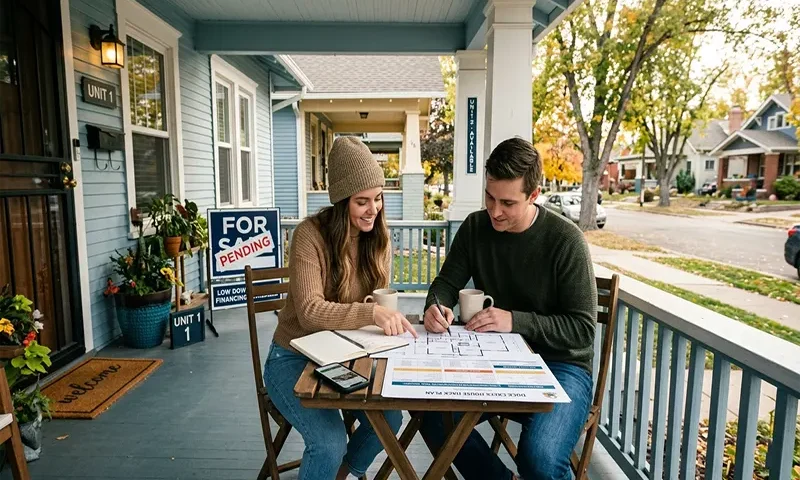
In the real estate landscape of 2026, the traditional “20% down payment” requirement is increasingly viewed as a relic of the past for entry-level investors. For those looking to achieve financial independence, house hacking has emerged as the premier strategy to bridge the gap between being a renter and becoming a property owner.
At its core, house hacking is the practice of purchasing a primary residence, living in one part of the property, and renting out the remaining space to offset or entirely eliminate your mortgage and housing expenses. By leveraging low down payment loan products, beginners can control a high-value asset with minimal initial capital, effectively using their tenant’s rent to pay for their own housing.
The Financing Secret Sauce: Low Down Payment Loans
The engine that makes house hacking possible for beginners is the availability of government-backed and conventional low-equity loans. These products allow you to enter the market with as little as 0% to 5% down, provided you intend to live in the property for at least one year.
| Loan Type | Down Payment | Ideal For | Key 2026 Requirement |
| FHA Loan | 3.5% | 2–4 unit properties | Must pass “Self-Sufficiency Test” for 3-4 units |
| Conventional | 5% | Duplexes/Triplexes | Competitive rates for multi-family |
| VA Loan | 0% | Veterans & Service Members | No PMI and extremely high leverage |
FHA Loans (3.5% Down)
The Federal Housing Administration (FHA) loan remains a staple for house hackers. While it requires Private Mortgage Insurance (PMI), it allows for a low credit score threshold. For 3–4 unit properties, the “Self-Sufficiency Test” is critical: the projected rent from all units must cover the total monthly mortgage payment.
Conventional 5% Down Multi-Family
A significant shift in the lending environment (initiated in late 2023) now allows buyers to purchase 2–4 unit properties with only 5% down using conventional financing. This is a game-changer for beginners who want to avoid the stricter appraisal and insurance requirements of FHA loans.
Four Primary House Hacking Strategies
1. The Multi-Family Play
This is the classic “gold standard” of house hacking. You purchase a duplex, triplex, or fourplex. You live in one unit and rent out the others. This strategy provides the most privacy, as you have your own kitchen, bathroom, and entrance while your neighbors (tenants) pay your mortgage.
2. The “Rent-by-the-Room” Model
For those in high-priced urban hubs or near universities, buying a large single-family home and renting out individual bedrooms is often the most cash-flow-positive move. While it requires sharing common spaces, the “per-room” rent often exceeds what a single family would pay for the entire house.
3. ADUs and Tiny Homes
With the 2026 emphasis on urban density, many cities have relaxed zoning for Accessory Dwelling Units (ADUs). House hackers can live in the main house and rent out a backyard cottage or basement suite—or vice versa—to generate significant supplemental income.
4. The Live-In Flip
While not a traditional “rental” play, the live-in flip involves buying a distressed property with a low down payment loan, living in it while renovating over two years, and then selling it. Under Section 121, you can often exclude up to $250,000 (single) or $500,000 (married) of the capital gains from taxes.
Running the Numbers: The Beginner’s Math
To ensure a house hack is a “deal” and not just a “purchase,” you must understand the basic math of cash flow.
- Gross Rent: The total income from all units/rooms.
- The 50% Rule: A quick benchmark stating that 50% of your gross income will likely go toward taxes, insurance, maintenance, and capital expenditures (excluding the mortgage).
- Net Cash Flow: Gross Rent – (Mortgage + Expenses) = Your monthly profit or savings.
Beginner’s Deal Analyzer Checklist:
- [ ] Does the market rent for the other units cover at least 75% of the mortgage?
- [ ] Is there an “opportunity gap” (e.g., underpriced rent or a basement that could be finished)?
- [ ] Are the utilities split, or will you have to budget for everyone’s electricity?
The Lifestyle Shift: Landlord-Tenant Boundaries
House hacking is as much a lifestyle choice as it is a financial one. Living in the same building as your tenants requires professional “soft skills.”
- Screening is Paramount: Since you will be living near these people, your screening process must be rigorous. Check credit, criminal history, and past landlord references without exception.
- Set Boundaries: Do not tell your tenants you are the owner if you want to avoid “knock-on-the-door” maintenance requests at 2 AM. Many house hackers refer to themselves as the “property manager.”
- Professionalism: Always use a formal, written lease. Even if you are renting to a friend, a lease protects both parties and sets clear expectations for noise, parking, and guests.
2026 Market Context
In 2026, interest rate stabilization has made house hacking a more viable “trade-up” tool than the volatile years of the early 2020s. With rates reaching a predictable plateau, investors can more accurately forecast their cash flow and long-term appreciation. Furthermore, the push for sustainable, high-density housing makes multi-unit properties and ADUs more attractive to a wider tenant pool looking for eco-friendly urban living.
The Exit Strategy: Scaling Your Empire
Most low down payment loans require you to live in the property for 12 months. After one year, you are free to move out, rent out your original unit, and purchase another property using the same strategy. This “rinse and repeat” method allows beginners to accumulate a portfolio of multi-million dollar assets in a few years with very little out-of-pocket cash.
By eliminating your largest monthly expense—housing—you accelerate your ability to save, invest, and eventually reach financial independence. House hacking isn’t just a way to buy a house; it’s a way to buy your time back.

